Tamara Rojo in Conversation
Tamara Rojo, celebrated dancer and Artistic Director of San Francisco Ballet, joins Graham Watts in Conversation.

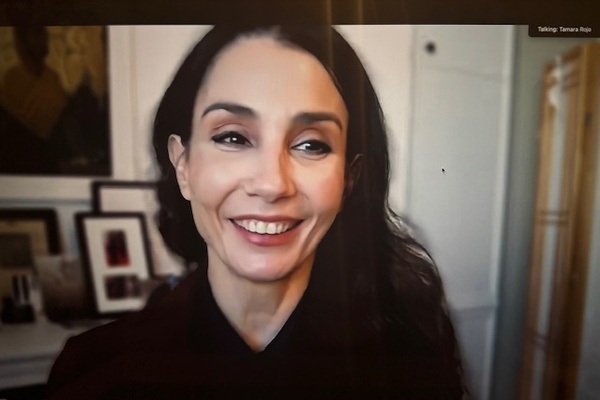
Tamara Rojo ‘in conversation’ with Graham Watts
3rd December 2025
The Chair of the London Ballet Circle, Susan Dalgetty Ezra, welcomed Tamara Rojo to the evening’s conversation. Born in Canada but with a long and impressive career in this country, she had been Artistic Director of English National Ballet (ENB) when last in conversation with LBC in 2022. Now Artistic Director of San Francisco Ballet (SFB), Susan thanked her for agreeing to offer some insights into her time in the USA. Susan also warmly welcomed dance critic and writer Graham Watts, who would lead the conversation, plus a number of new viewers from the San Francisco area.
Graham commenced by asking about California, it being three years since she took up the artistic leadership of SFB. Tamara responded that it had seemed a very fast three years. Relentless, which is normal at the beginning of a tenure. However, she felt very much part of the amazing creative community of the city, of which they are very proud and supportive. Nevertheless, her 27 years in the UK had completely shaped her ethics and views, especially about the performing arts and the importance of culture. I'm somewhat British, said Tamara, and that will never change. And I do miss the British sense of humour!
Graham then mused as to why the ballet company was so highly regarded when San Francisco itself was a relatively small city. Tamara replied that one reason was its historically great leadership, originally through the Christensens and, more recently, Helgi Tómasson. Internationally minded, always very aware of new choreographers, always creative.
They are risk takers by personality in San Francisco, she said; there is a reason why this is Silicon Valley, a reason why AI is being created here, that's the mentality of the place.
The discussion then turned to comparisons between ENB and SFB, probably the biggest difference being the absence of public funding in the USA. And although when Tamara left ENB it was below 40% of the budget that, she said, is still a nice safety net to have when you're making artistic decisions. SFB must rely on the box office and donations. But she has found most encouraging and rewarding the personal investment of donors, often second or third generation, indeed entire families with a history of caring and valuing an institution.
About a year after she joined the company it received a record-breaking anonymous bequest of $60 million. Graham wondered if it had placed any particular constraints on Tamara as artistic director. None, she replied. It was a very generous donation to support risk-taking and both the creation and acquisition of works that had never been presented by the company. A donation to give her more freedom! We now have an amazing new executive director, Branislav Henselmann, she said, who has introduced some incredible initiatives to bring in revenue. So SFB is in a very exciting time; what that donation did was provide a bridge to a new way of running the company.
Graham also suggested that SFB feels very much like a city, or maybe state, company but certainly more localized in its reach than the ‘national’ ENB. Tamara did not agree that was entirely fair. Most of the choreographers who had shaped the last 20 years had their first opportunities at SFB. And while the company spends some six months in the city, performing non-stop, it has still had an enormous global impact supporting choreographers like, for instance Christopher Wheeldon, Liam Scarlett, and David Dawson. There is also a full touring programme, visiting venues such as Los Angeles, developing a sense of being a ‘California’ company – especially as there really isn’t much more ballet in the State. And twice this year to New York, and then the Edinburgh Festival….
Graham noted that often where you've had a long-serving leader in any role, not just in ballet, it can be difficult to change the direction of a company. Tamara didn’t think it had been particularly difficult from that point of view, but she has always been very respectful to the legacy. Why bring your Swan Lake or Don Quixote when the company has its own successful version? I'm here because I have a vision for the organization, and I want the dancers to have the best possible career. I want the audience to have unforgettable experiences every time they come to the theatre – that’s Tamara’s philosophy.
Well, Wayne's (McGregor) Nutcracker survived your entire reign at ENB, said Graham. So I think we could describe your style as evolutionary rather than revolutionary – Tamara agreed. And you've got Helgi’s Nutcracker starting in two days' time. Tamara also noted they had reached a box office record of $12 million for Nutcracker.
Graham then expressed approval for the SFB mounting a new version of Eugene Onegin, choreographed by Yuri Possokhov with music by Ilya Demutsky. It sounds like a recipe for a very Russian take on the most Russian of stories, he said.
In explanation Tamara said that Yuri has been their resident choreographer for some 20 years. He had made many works for the company, but never a full-length piece. She had seen the premiere of his Nureyev at the Bolshoi and been completely blown over, by both the music (also by Ilya) and the choreography. Since Yuri was an extremely talented choreographer, Tamara asked him what he would like to do. And he admitted that he had been waiting for years for the opportunity to do Onegin.
It will be very different from John Cranko’s Onegin, said Tamara. A completely different take, as you say, very Russian, almost surrealist. I find that Russian theatre, but also Russian literature is very similar to a certain extent, to South American, in that magic surrealism.
So let's look at your repertoire after January, suggested Graham. A very traditional Don Q, Les Sylphides, and of course the Balanchine program. But also some links back to ENB with Bill Forsythe's Blake Works, and a new piece by Aszure Barton, who you introduced at ENB. How keen is the audience in San Francisco for new work? Tamara responded that in London repertoire is somewhat shaped around the venue. The audience goes to Sadler’s Wells for new works, to the Coliseum for the more traditional classical works, with the Royal Albert Hall demographic being different again. She said that the staples are great for the box office, and she always wants to have works for families and children. Nevertheless, there is a real interest and desire for mixed bills, for new creations, in a way that perhaps didn't always feel as safe in the UK.
At ENB Tamara tried to diversify audiences. For instance the all-women programmes She Said and She Persisted. She believed it her job to try to make everyone feel welcome, to make them feel accepted in the theatre. Thus she had brought to SFB the Broken Wings ballet, drawing on the life of Frida Kahlo. Again, Chinese designer Tim Yip was responsible for Onegin, in a city with an enormous Chinatown area. Mere Mortals, a piece by Aszure Barton and Sam Sheperd, had very much changed the audience demographic, bringing some 10,000 people – many young – who had never been to the Opera House. The Billy Forsythe program should bring yet another different audience.
Tamara went on to talk of the SFB Gala Night, a sparkling and legendary occasion very American in concept, most enjoyable but also so valuable for encouraging donations to the company by entertaining benefactors and their friends.
Graham noted that in this country Tamara had always been seen as a dynamic leader across the arts community. Had she continued in this role in San Francisco? She responded that she didn’t think she’d be capable of keeping her head down anywhere! For instance, she had been invited and spoken to a United Nations meeting in New York…. She felt she always had a duty to lobby for the performing arts, in whatever forum she could access, and whether it involved philanthropy or public funding.
He also revealed that Tamara had obtained a PhD through research, a most unusual task for a dancer to embark upon! Her thesis was on the psychological profile of the elite dancer and Graham wondered what she had learned during her research. A great deal about the history and development of the artform, she replied, and the way in which performance is affected by individual attitudes. Her research had originated with tests employed by Olympic team selectors to determine which athletes might be the most valuable to work with. It is clear there are many overlaps between training for dance and for sport!
May we talk about your own choreography, asked Graham, you’ve made a new version of Raymonda, set in the Crimean War. I imagine the scenario, for instance, the involvement of Florence Nightingale, may require a bit more explanation in San Francisco than it would in London. Tamara admitted that she had revised the ballet slightly before its performance by SFB. The core story remains the same, nevertheless, it’s good to be able to modify a piece based on experience and audience reaction.
She has also made Cinderella for the Royal Swedish Ballet. Would this be coming to SFB? Unlikely, she responded, the company already mounts the Wheeldon version; that’s a masterpiece and she has no wish to change that.
What do you think may have been your legacy of ten years at ENB, asked Graham. Tamara thought carefully about the question and responded that she might highlight three particular achievements. Introducing transformations of the classics. She recalled the consternation generated by the idea of Akram Khan’s Giselle – until its first performance…. Encouraging and bringing on female choreographers. And lastly the infrastructure; during her tenure ENB moved into wonderful new premises.
And will we ever see you dance again? I have been asked, Tamara replied, but I’m not sure that I could ever attain the sort of standard which I would require of myself. However, never say never…. She said that she had a wonderful dancing career, although she sometimes wished that she had been braver and taken a few more risks…
And your greatest wish for Christmas? A break! Time off, she replied immediately!
The evening concluded with a number of questions from the audience. Tamara was first asked if she might bring Giselle to SFB. That, she said, is entirely up to Akram, it’s his show, although she would like to do so. And Broken Wings – that also may be coming to SFB.
There was also a question about successes and failures to which she responded that while success is great, there is always something to be learned from failure of whatever kind. In seeking new commissions Tamara looks primarily for relevance, the opportunities for dancers to do their best and for audiences to have the best possible experiences.
And what about streaming shows over the internet? Very difficult. She would like to do so, but the various regulations and union rules rendered it extremely problematic, certainly at the moment.
The new Onegin ballet is being co-commissioned with the Joffrey Ballet. She was asked what advantages that conferred? The cost of production, choreography, music, and all the physical properties is shared. But it also allows more time for setting and rehearsing the piece. For instance, SFB allowed six weeks and Joffrey the same giving 12 weeks in all. You wouldn’t be able to allocate 12 weeks to a single production in SFB’s very full and busy schedule.
Finally she was asked about Marguerite and Armand, and whether the piece had some special meaning for her – as seemed obvious from the SFB website. Tamara agreed that she felt very close to the originals having worked with Lynn Seymour and other stars of the ballet world. She believed she properly understood the piece and the intentions of its creator, and passing that on to a new generation was extremely moving.
In concluding the evening, Susan, chair of the London Ballet Circle, responded enthusiastically that it had been yet another truly fascinating discussion. She said that Tamara was clearly doing a great job in San Francisco, although very much missed from the British scene. A pity that San Francisco was so far away…. She thanked both Tamara and Graham most sincerely for a terrific evening’s conversation.
Trevor Rothwell 05-12-25
Copyright @ The London Ballet Circle


