Samara Downs in Conversation
Samara Downs, principal dancer with the Birmingham Royal Ballet, joins Brandon Lawrence in Conversation.

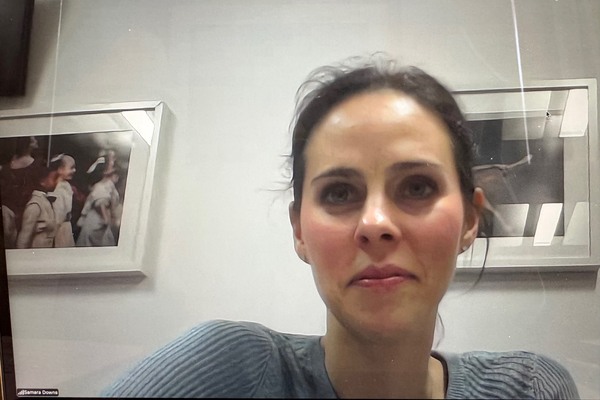

Samara Downs ‘in conversation’ with Brandon Lawrence
5th February 2026
The Chair of the London Ballet Circle, Susan Dalgetty Ezra, welcomed Samara Downs to the evening’s conversation. Samara is a Principal Dancer with Birmingham Royal Ballet (BRB), having trained at the Royal Ballet School. Renowned for her sensitive interpretation of the English ballet repertory, she is currently a Benesh notator and a member of the Ashton Stagers’ programme. Susan also welcomed Brandon Lawrence, an ex-colleague from BRB, now dancing with Ballett Zürich, who would lead the conversation.
Brandon opened the conversation by asking Samara what she had been doing during the day. A full call for Don Quixote, she responded, saying that she was to play the roles of Mercedes, Queen of the Dryads, and Dulcinea. And that it was her first time in the ballet, having been on maternity leave when it was initially staged, so it was all new to her.
There must be few major roles you haven’t danced, said Brandon, and really you’ve had a dream of a career. However he didn’t want to rehearse her career in any detail because, as he said, it’s all out there for anyone to read about. But perhaps we can explore who has been important to you over the years? Patricia Linton, her teacher at White Lodge, she replied immediately. Probably most important, she had taught students how to focus, to knuckle down and work hard. Her year group at White Lodge had been full of dancers who had subsequently made their names in the profession. Together with White Lodge she also emphasised the value of attendance at Yorkshire Ballet Seminars, particularly with Kevin Haigen, who was Ballet Master at Hamburg Ballett at the time and was a greatly inspiring teacher.
(Sir) David Bintley, then Artistic Director of BRB, had invited Samara to join the company following a tour during her third year at the Royal Ballet School, telling her that she was ‘interesting’ She had learned so much from him and from Marion Tait, Assistant Director of the company, both of whom were masters of nurturing the individual and developing the characters of the particular roles being danced.
Story telling was important to Samara and she had played many of the ‘character’ roles, for instance, Carabosse and Lady Capulet, before taking on some of the ‘tutu’ roles. She was particularly fond of Lady Elgar in Enigma Variations and Natalia Petroneva in A Month in the Country, the ballet based on Turgenev’s play. Both works are by Ashton whose characters are always so deep and well formed. She had the good fortune to play Lady Elgar very early in her career; she’d played Natalia only once but noted that it was an amazingly ‘meaty’ part.
Other highlights she mentioned included La fille mal gardée and Swan Lake – which she referred to as a ‘bonkers’ story but one which demands a whole spectrum of emotions, having an incredible emotional narrative which develops over the course of the ballet. Another significant piece is MacMillan’s Concerto; she had performed the 1st Movement girl while still at school, the 3rd Mov girl with the company, and had recently taught the 2nd Mov to London City Ballet – thus it is a ballet which has seen her transition from student, through to her professional career and then beyond into setting and staging ballets.
Samara was asked what differences she had noticed when David Bintley retired and Carlos Acosta took over at BRB. Naturally there was a different focus on the repertoire, because they were quite different people, and there had been several changes among both the staff and the dancers. However, alongside the new works they still staged the perennial favourites such as Swan Lake and Nutcracker. And, of course, the economic situation was now very difficult. But, she said finally, it’s still a lovely company!
So let’s get on to your involvement with Benesh Movement Notation (BMN), said Brandon. His group had just touched on it at school, but really it was a very specialist area. What had sparked her interest? Samara replied that she had always been fascinated with languages and that the system was utilised quite extensively by BRB. BMN allows the recording of movement, and is crucial in recording the intention of the work, so that it can later be faithfully reconstructed at any time in the future. It uses a similar system to music notation in that it is recorded on a 5 line stave with many of the same fundamental constructs, such as bar lines, rhythm notation and legato lines. However in the case of BMN, rather than indicating pitch, each of the lines on the stave represents a different level of the body; the bottom is the floor line, the second stave line the knees, the third represents the waist, the fourth line is the top of the shoulders and the top line shows the top of the head. The BMN score relates directly to the music score since the staves align with musical bars for precise timing.
Benesh Movement Notation was devised by the mathematician and choreologist Rudolph Benesh together with his wife Joan, a dancer with Sadler’s Wells Ballet, during the early 50s, being published in 1956. It was taken up by the Royal Ballet and further developed in conjunction with the newly created Benesh Institute of Choreology. There are now centres for learning in the UK (Benesh International) and France (Conservatoire National Supérieur de Musique et de Danse de Paris), and BMN is used to set and stage works in ballet companies all over the world.
Over the years several key notation systems have been introduced. Another in current use is Labanotation, slightly more flexible and less precise, and perhaps better suited to contemporary dance styles. This is the system that was used to record the seminal work by Kurt Joos The Green Table which is being performed by BRB in June 26. An effective notation system can allow a work to be staged at any time even when there may be no other information available, although Samara stressed the value of also using as many other sources as may be available – photos, videos, direct face to face advice from past performers, even reviews of the work when first performed.
Notating a ballet is not a quick process; it was suggested that it could take 8-16 hours simply to record one minute of choreography! Being a language, however, it is flexible and has evolved quite effectively to cope with more ‘extreme’ movements such as those employed by choreographers like Wayne McGregor. It has also been used extensively as a tool in anthropological research and even in clinical settings to help record movement patterns (such as gait) associated with medical conditions.
Is there a central library of Benesh books, inquired Brandon. Yes, Benesh International holds a huge collection of scores which can be accessed by members. However, sometimes annotations are made, by the choreologists, on the facing pages of working copies of the scores in companies where the repertoire is performed regularly, and these act to document the evolution of the work. The central library will not always hold these updated annotated copies.
Brandon touched on what BMN projects Samara had been involved in, to which she replied she had been lucky enough to have been involved in two reconstruction projects, the first being with London City Ballet, on Ballade, a MacMillan ballet for which only the notation was available. Loosely based on MacMillan’s first date with Deborah, his wife-to-be, the piece is short, minimalistic in nature, and involves just four dancers. She has just completed a reconstruction of Ashton’s pas de deux Scène d'Amour for BRB, choreographed on Fonteyn and Soames in 1959, and created as a test piece for a potential full scale production to Glazunov’s beautiful score of the same name. Also she staged La Valse for the Royal Ballet School, another Ashton ballet, to wonderful music by Ravel and depicting a ballroom in classical Vienna involving many dancers. Benesh Movement Notation, said Samara, is brilliant for recording groups of dancers because each can be followed individually.
As part of the Ashton Stagers’ programme Samara is intimately concerned with reconstructing and staging the ballets of the great Frederick Ashton, hence her involvement with these pieces. She is currently shadowing The Dream, based on A Midsummer Night’s Dream and with music by Mendelssohn, with a view to staging it in the future. She is also reviving his Lament of the Waves, a one act ballet, for the Frederick Ashton Foundation. This latter work, she said, presents problems with the music as the orchestral resources required by the original score are too large for today’s budgets and piano transcriptions are needed. All of this is being accomplished alongside her performing responsibilities at BRB; she fits in study during rehearsal ‘downtime’, while at home she works once the children are in bed. Brandon readily concurred with her admission that she likes to keep busy!
Brandon then asked whether Samara could point to specific positive or negative aspects of her long career. Refining a role, getting it absolutely ‘right’; especially when it involves partnering, there is something terrifically satisfying in being able to find exactly the right position with your partner. They both recalled a particular pas de deux in Carmina Burana which they had performed together and which exemplified just what she was attempting to describe.
And as for the negative aspects, Samara spoke of the situation in which one day you are the expert, you’re top of your game – and the next day you have retired from the ballet, left dancing behind. That transition had to come for every dancer and she emphasised the importance of preparing for it beforehand. Think it through; what are your interests? What could you do? Start exploring the possibilities well before it happens, as she had done.
Samara spoke with gratitude of the support afforded her by BRB when deciding to train to be a specialist notator. And a charity – Dancers Career Development – had been of enormous help in providing funding and other support for her courses. Along the way she had also obtained a Master’s degree in Philosophy and Psychology, based on research on the way in which dancers coped with stress, and whether this had any influence on their propensity to get injured – which she believed it probably did.
Coming to the end of their chat Samara was asked about particular highlights of her career. Her performance in La Fille, A Month in the Country, even perhaps in Two Pigeons. And would she consider taking on any new role? I’m up for anything, she said, learning a new piece makes it so much easier to subsequently teach.
In concluding their conversation Brandon quoted from a review of one of Samara’s performances, in which critic Mike Dixon had referred to her, in a good way, as an ‘old fashioned ballerina’. Brandon concurred, with considerable approval!
In concluding the evening, Susan, chair of the London Ballet Circle, responded enthusiastically to the evening’s discussion which had really been just a very lively chat between good friends – inspiring and most enjoyable. She thanked both Samara and Brandon most sincerely for a terrific conversation.
Trevor Rothwell 08-02-26
Copyright @ The London Ballet Circle


