Mime in Motion
A special collaboration between the London Ballet Circle and GradPro to celebrate the expressive art of mime.

Mime in Motion
A collaboration between GradPro and the London Ballet Circle
21st October 2026
Susan Dalgetty Ezra, Chair of the London Ballet Circle, warmly welcomed participants and audience both in person and online to the Royal Ballet School for the evening’s event, Mime in Motion. This first collaboration between the London Ballet Circle and GradPro is to be a celebration of the expressive art of mime, explored within the traditions of classical ballet while also looking towards its future. She introduced Julie Bowers, the founder of GradPro, and Alex Harrison, teacher at Elmhurst Ballet School, who would host the evening.
Alex explained that the idea arose after Marion Tait had coached the role of Carabosse (The Sleeping Beauty) at a GradPro summer school. She had delivered an absolute masterclass in storytelling, and the response from the students was remarkable. Overwhelmingly, their feedback was that they absolutely loved this session.
Their delight really stayed with Alex and got him thinking about the importance of mime within classical ballet, how fundamental it is to storytelling, characterization, and dramatic expression. And yet, how little opportunity there seemed to be to study it in depth in vocational ballet training today. He also became increasingly aware of how little he himself knew about the technique of mime, how it's taught, and especially how its nuances are understood by an audience.
Feeling there was a great opportunity to explore this further, he approached Julie to see whether she might be interested in collaborating on an event dedicated to the subject. Thankfully she was enthusiastic about the idea, as was the London Ballet Circle.
So, he said, this evening will be an opportunity to watch two coaching sessions led by remarkable and very talented coaches. Alex also wanted to explore how mime might speak to dance today, how it might act as a catalyst or a stimulus for creating new movement. And so to complete the evening, choreographer Daniel Davidson will share the work in progress of a new piece for the GradPro dancers.
Julie explained that she and Brandon Lawrence started GradPro just after the pandemic to provide performance opportunities and support to vocational graduates. It has evolved and snowballed and is now a vital transitional bridge for graduates venturing into professional contracts. To date GradPro has opened important doors for 67 graduates, with contracts throughout the world.
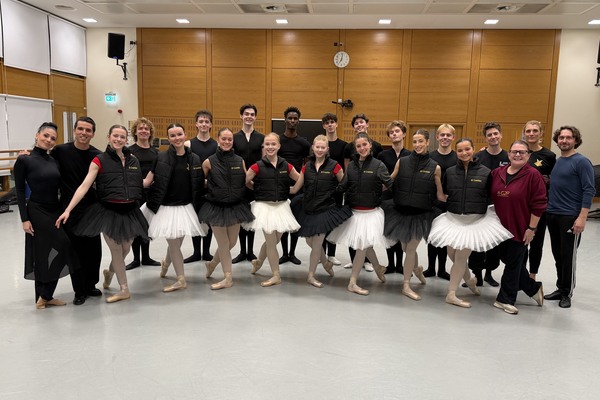
She went on to introduce the dancers who were to take part this evening, explaining that the eight ladies were all on the Birmingham GradPro (G2P) pre-professional course. She had also secured the services of eight gentlemen, from a variety of sources. All were invited to introduce themselves. Ross Alley would be the pianist for the evening.
Coaching the eight couples for the first session were Ivan Putrov and Zenaida Yanowsky, both former Principals of the Royal Ballet. They commenced by explaining that while dancers must warm up their bodies, they also have to prepare themselves emotionally for a role. To lose their innate shyness, to be explicit with their movements so as to let the narrative come through. Some dancers are better than others at this, they noted, but really it’s a question of preparedness.
In answer to an audience question they agreed that the gestures used in ballet, for example for ‘sleep’ or ‘my heart’, were to an extent universal. However, variations existed between companies and choreographers, which emphasised the importance of ensuring that every gesture was plainly executed so that its meaning was clear to the audience.
This first session involved part of the initial meeting between Prince Siegfried and the white swan, Odette, from the second act of Swan Lake. This segment relates her back story and effective mime is essential to convey the message clearly to the audience. For instance that she was the queen of the swans, that she lived on an enchanted lake formed from her mother’s tears, and that a wicked curse had turned her into a bird. For his part, the Prince must move with care, offering support to Odette without scaring this sensitive bird/woman any further. At the same time he must not simply stand like a statue; he must be attentive and responsive to Odette’s actions, while allowing the audience’s attention to focus on her. Through repetition the dancers were taught the value of clear and expressive movement, mostly soft and gentle, particularly of the hand and arms.
The next session was very different. Carabosse, the wicked fairy in The Sleeping Beauty, is a very assertive individual. When first she comes on stage her manner is calm and friendly but is completely transformed when she discovers she has been omitted from the guest list of Princess Aurora’s christening party. She storms across the stage and castigates a poor official (Catalabutte) for the omission. Carabosse then lays a curse upon the infant, demonstrating how she will grow into a beautiful girl until her 21st birthday, when she will prick her finger and immediately die, these actions requiring careful, deliberate visual explanation.
Coach for this session was Daria Stanciulescu, Principal Character Artist with Birmingham Royal Ballet. Working with three of the ladies and two men – Carabosse can be played by a woman or a man – she demonstrated the sharp, dynamic, much more sudden movements necessary to show the ‘wicked’ nature of Carabosse’s character. The swift removal of Catalabutte’s wig and a remaining hair; the sudden, almost explosive demonstration of the way in which Aurora is going to prick her finger.
Daria noted that in most productions Carabosse’s costume was big and complex, and incredibly heavy, and that the dancer had to take this into account when preparing for the role. She believed that mime and stagecraft should be included in all training programmes; the way in which a dancer presents him or herself in a role can be as important as the sheer ballet technique involved.
In The Sleeping Beauty the wicked fairy Carabosse is followed by the entrance of the Lilac Fairy, who (fortunately!) is able to modify the curse; Aurora would not die but would instead fall into a deep sleep from which she could be woken only by a true love kiss. Working with the remaining five ladies Daria went through the mime necessary to explain to the audience exactly what the Lilac Fairy was able to achieve and how she will mitigate the curse.
The final session of the evening was different again. Daniel Davidson, who danced with Scottish Ballet and Rambert, is now a freelance choreographer who has worked with many different ballet companies. He has been working with GradPro on a contemporary piece which incorporates and integrates the dancers’ own gestures. I, you, love, listen….
The piece was danced by all 16 dancers; it was intricate and involved both solo and group work and the talented performers appeared to enjoy the experience of a rather different approach to dance – demonstrating the versatility of the dancer of today.
This, Daniel said, is very much a work in progress. Selecting the accompaniment for a contemporary piece usually involves electronic music but this time he has tried something new; incorporating the dancers’ own voices to compile a layered soundscape. A different but absolutely fitting end to a most interesting programme.
An audience question concerned the potential for mime and emotional gestures to be of therapeutic use, say for individuals with cognitive or neurological problems. Zenaida responded that she was currently working with a Parkinson’s Disease group which was finding it useful. Another question concerned the difficulties of encouraging expressiveness in hesitant student dancers. Alex responded that the over-riding element of school life was that every student should feel safe, positive, and encouraged to participate to the full. And on stage one can utilise one’s own emotions, although not so much that it takes away from the performance.
In her closing remarks Julie emphasised the importance of coaching by talented individuals, so that when coaches of the stature of Daria or Marion (Tait) walk into the room the students are immediately focussed. And that is one of the lessons GradPro can offer. She thanked all of the evening’s performers most sincerely, thanks which were reiterated by Susan as Chair of the LBC. The future of ballet is in good hands!
Trevor Rothwell
24-10-26
© The London Ballet Circle


