Melanie Simpkin In Conversation
Head of Benesh International at the RAD, Melanie Simpkin, joins Alexander Campbell in conversation.

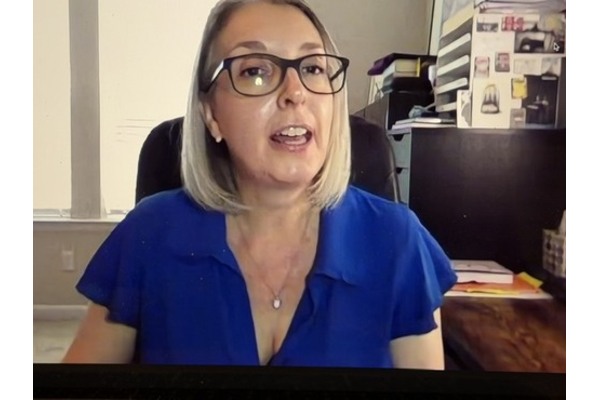
Melanie Simpkin 'in conversation' with Alexander Campbell
11th May 2026

Susan Dalgetty Ezra, Chair of the London Ballet Circle, warmly welcomed Melanie Simpkin to the evening's conversation. Melanie is Head of Benesh International at the Royal Academy of Dance (RAD). Training as a dancer at the Arts Educational School and then the University of Surrey, she decided to specialise in Benesh Movement Notation (BMN), graduating as a professional choreologist in 2010. Susan also welcomed Alexander Campbell, former Royal Ballet Principal dancer and now Artistic Director at the RAD, who would lead the evening's conversation.
To many of us Benesh Movement Notation is a foreign language and accordingly Alexander first invited Melanie to provide a 'crash course' in its basic structure and thus offer a glimpse of its magic. Melanie explained that BMN was devised in the 1940s by Rudolf Benesh, a mathematician and artist, and Joan, his wife, a dancer. It was launched publicly in 1955 at the Royal Opera House to an audience including Dame Ninette de Valois, and so last year its 70th anniversary was celebrated.
At rehearsals Joan made notes, written in longhand, in words which could be all too easily misinterpreted later, so between them they devised their own system of notation. The system which they developed can record any form of human movement and thus can be used in disciplines other than dance. It allows choreographers and other movements specialists to record physical movement in a codified way, using a codified vocabulary.
Melanie went on to describe carefully and in detail the various elements of BMN by presenting a series of diagrams. All that can be covered in a brief written report is the broad theory which lies behind these elements. The basis of the notation is a five line stave, just as in music, with each of the stave lines indicating height in relation to the dancer's body:
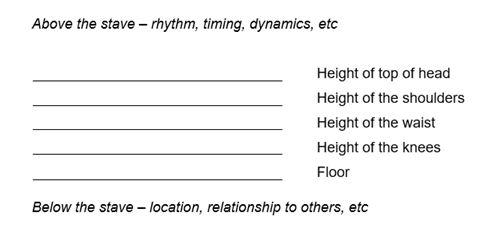
Each zone can thus provide a visual guide to the movement or positioning of a specific part of the body. The stave is sub-divided into frames marking the passage of time, the equivalent of bar lines in a music score (in fact, the number of bars in a piece will equate to the number of bars in the accompanying music score) and the score is read from left to right.
A (virtual) centre line is drawn vertically through each frame, and the position of the various elements in relation to this centre line can record the precise placement required, for example, is the hand extended to the side as far as possible or kept close to the body. While the dancer performs in three-dimensional space, BMN records in just two dimensions. Accordingly further symbols and characters are necessary to record this third plane, for instance, whether the hand is to be held in front of, behind, or level with the body itself. And further small dots or lines depict the precise orientation of an individual hand or foot.
Within the frame everything must remain in proportion anatomically. The observer is looking at the dancer from behind, so that every movement of the right side of their body will be depicted on the right-hand side of the image. That convention is clearly important and must be maintained.
Above the stave will be recorded information about rhythm and timing. Also dynamics, such as whether the movement is forceful, or perhaps softer. Below the stave goes information about, for instance location, where in the performance area is the dancer working. Which way is the dancer facing, which way a turn, what is the relationship to others on the stage? In principle, a BMN score will allocate one frame to each element of dance activity, using further symbols to indicate where and how individuals might interact.
Although entirely logical a completed BMN score looks baffling to the untrained eye. Witness the following fragment from the score of Christopher Wheeldon's ballet Within the Golden Hour, which records steps for four dancers and the way in which they relate to each other:
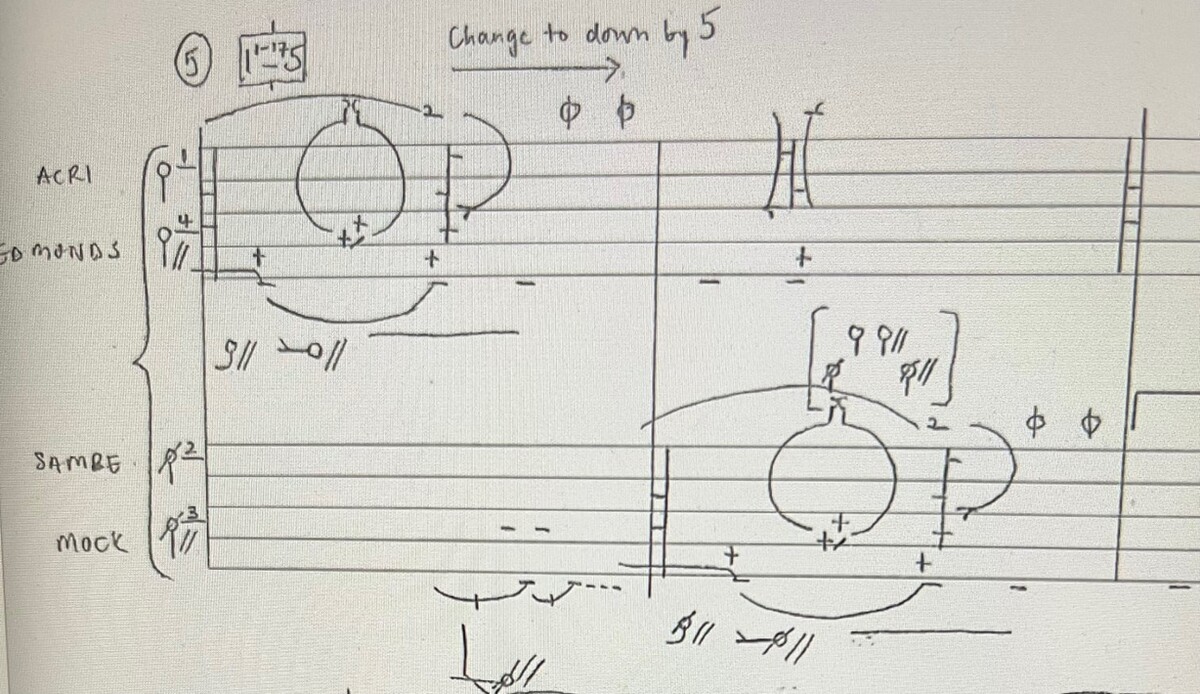
The choreologist will sit alongside the choreographer when a ballet is being created and compile the score. This exercise can often prove invaluable when, for instance, the choreographer revisits a particular passage and may be uncertain as to what steps had been created. The current state of BMN is such that it is now accurate, clear, and succinct, opined Melanie. Scoring a ballet remains, however, dependent on the skill and experience of the choreologist – but also the time available in which to carry out the exercise. Notating is not a quick process!
The question was posed as to whether video recording can (or perhaps will) replace notation. It can be complementary, responded Melanie. A video records just a single moment in time. It is certainly valuable to see a step rather than having to work it out from a score, but is that step correct? Is it what the choreographer intended?
Prior to recording a ballet could only be handed on by word of mouth – by being taught it by those who had performed it on previous occasions. And that process remains a vital link across the years, even though memory can inevitably be fallible. Notation, however, results in an independent and unchanging record of a work which, in conjunction with both video and personal memory can ensure the continued accuracy and authenticity of works.
Which is not to say that a notated score will remain pristine. Indeed, a score will probably have pencil notes all over it, recording changes made in individual performances, but the record made when the work was created will still be present. Thus a score will probably show the history of a work, how it may have been adapted and altered over time.
Melanie gave an example of the need to sometimes amplify the notated record. On one particular occasion a dancer's hands had to appear as if they were holding a sphere, a globe of ‘energy’, twisting their hands around it to turn it one way and another. The action required a written note in addition to the notated record. Such specific imagery requires something extra to let the dancer know what the choreographer intended.
Then Alexander himself recalled an evening in which for some reason he was a little late on his entry and had turned left instead of right – and it was being filmed! Years later when the ballet was being restaged he happened to visit the rehearsal. There was discussion about this entry; the film showed left, while the BMN score indicated right. He had to admit that on the night he had been in error – once again demonstrating the value of the notated record.
The RAD library contains many BMN ballet scores, plus those made on other dances. One notable recent example is the notation record meticulously produced by a Brazilian traditional dance group, but there are also scores of South African, Estonian, Tahitian dances.... Yet more scores are held by the Royal Ballet and other companies.
Use of Benesh Movement Notation extends well beyond dance. In the medical field, for example, it has been used to identify and analyse the gait of individuals suffering cerebral palsy and thus assist therapists in formulating strategies for rehabilitation. Football coaches have used it to analyse their 'set pieces' and suggest significant changes to their training. And French gravediggers employed a BMN notator to record their work and were thus enabled to correct their digging performance, resulting in reduced neck and back pain.
Alexander then went on to ask Melanie how she had become involved in notation work. She responded that when a child, probably eight or nine, she had a book of the performing arts. In the chapter on ballet was a single frame of notation and a tiny bit of information on how to read it. That was her introduction to notation – wondering how that sketch translated into a ballet position.
Years later she took a dance degree at Surrey University, the course including study of both Benesh and Laban notation alongside each other. Laban had not made much sense to her, being written vertically up the page and looking very different from Benesh. Once she knew what she was looking for, BMN made sense; the flow of one frame to the next, the movement across the page. She remained fascinated, and some years later had been able to pursue a career in the specialism.
Can you visualise a ballet simply by looking at the score, Melanie was asked. Yes, although it can take a little while, she responded. Indeed, she had taught ballets simply from the score although it was necessary to get the steps into your own body first, she believed. One doesn't want to be trying to teach with the score in one hand. Then teaching it with confidence – that's a real skill, she said, while admitting that she hadn't always mastered it.....
Budding notators today can study via a beginner's distance learning course with Benesh International at the RAD. Bearing in mind that many students are active dancers seeking a 'post-dance' qualification, the study can take more or less as long as needed. After that will come a certificate course, three years, again part-time, probably involving some 20 hours study each week. Graduates from that programme can then apply for the diploma programme, success in which allows the student to practise professionally. That programme includes a placement with a company in which the student is expected to follow through notation of a new work from inception to first performance.
It is not essential to be able to read music, said Melanie. Benesh International teaches notation as if it was a completely new foreign language. But knowledge of music is certainly a great help. For instance, one must be familiar with counting the steps and relating this to the music score. Individuals from a wide range of disciplines have successfully completed the programme – Melanie recalled one student whose day job was in veterinary science!
Susan thanked Melanie for a wonderful and fascinating insight into the magic of Benesh Movement Notation and also into the role of a choreologist. Alexander had been a thoughtful interviewer, asking all the right questions. She thanked them both most sincerely for providing the Circle with a most interesting evening which had been absolutely delightful.
Written by Trevor Rothwell, approved by Melanie Simpkin and Alexander Campbell.
Copyright @ The London Ballet Circle


