Joy Annabelle Womack in Conversation
Joy Annabelle Womack, an internationally celebrated ballerina, educator, and author, joins Gerald Dowler in Conversation.

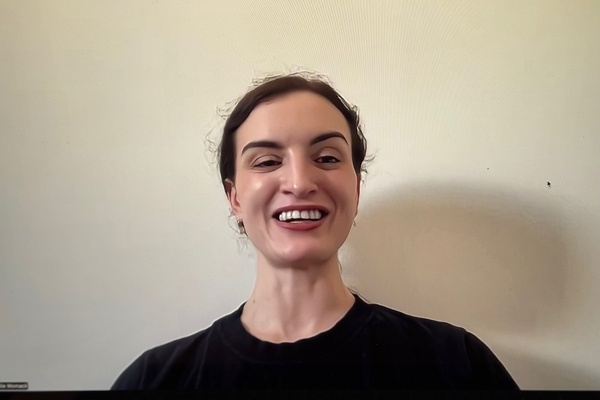
Joy Annabelle Womack ‘in conversation’ with Gerald Dowler
13th December 2026
The Chair of the London Ballet Circle, Susan Dalgetty Ezra, welcomed Joy Annabelle Womack to the evening’s conversation. Born in Santa Monica, and now an internationally celebrated ballerina and educator, Joy was the first American woman to graduate from the Bolshoi Ballet Academy and sign a contract with the Bolshoi Ballet, going on to dance all over the world. Susan also warmly welcomed dance critic and writer Gerald Dowler. Taking up the conversation, he also commented that Joy had indeed had more careers in more places than probably any other dancer.
Gerald started by asking Joy about her presence on the Prix de Lausanne jury panel. She replied that it had been an extreme honour to be invited. Traditionally dancers remained with a single company for much of their dancing careers and thus she felt that her own broad range of experience was valuable in providing a new perspective for the jury. That could be especially important today when so many young dancers may be looking forward to a career much broader than just classical ballet. She went on to compliment Kathryn (Bradney) on the fair and unbiased scoring system used at the Prix, in which each jury member independently records their own assessments and scores, coming together at the end to rank the candidates.
So what were you primarily looking for in these young competitors? Personality, responded Joy, and bravery. Ballet is hard, and it’s a very stressful week! To her the whole package is rather more important than superb technique. Dance itself evolves, and those taking part were much more versatile than their forebears. Indeed, a new generation of dancers was wearing technologically advanced pointe shoes some elements of which were plastic – a revelation which took Gerald by surprise!
Joy went on to express some personal concern about the range of dance styles included in competitions these days, wondering how this versatility affected dancers’ bodies, and if, maybe, it resulted in more injuries. And was it entirely appropriate? If you go to a classical ballet school should you not be concentrating on classical ballet? In that regard Joy would like to see more works devised based firmly in classical techniques, although probably telling modern themes and stories.
The Prix is an excellent competition, said Joy. In general, however, in company with many influenced by the Balanchine tradition, she was rather against competitions for very young dancers, say, the under-15s. Training for competition involves concentrating on individual solos, to the detriment of group dances or corps de ballet work. And it can be very intense; you can lose sight of your home life balance. But that was not the Russian view, said Joy. At Russian ballet galas the dancers are announced with the prizes they may have already won. That, she surmised, is because each school has to publicly demonstrate that it is the best – a belief embedded very deep in Russian culture. Thus from the age of 17 until 25, while with the Bolshoi Ballet Academy, she entered many competitions.
Joy then went on to explain that she had first danced around the age of three, entered into a class to divert some of her abundant energy. As the years went by she found that she loved it more and more, dancing allowing her to stand out as unique in a family of nine children. There was a big culture of excellence within her family; if you did something, even as just a hobby, you had to approach it seriously. Somewhat of a loner by nature, she also loved reading. White Lodge and the Royal Ballet had been discovered in this way, with the revelation that there were children who attended ballet class every day! That was what she wanted!
And so, at the age of about 9 or 10, Joy and her mother went to her teacher to explain that she wanted to take part in daily classes. She felt entirely at home in the studio and in fact believes the dance studio has always been her happiest place. The school had been founded by Yvonne Mounsey and followed the Balanchine style and tradition, and even at that age Joy’s aspiration was to join New York City Ballet (NYCB).
And then, at age 12, her family moved to Austin, Texas. Joy was devastated. This would be the end of anything she wanted to achieve in ballet. She was convinced it was a major tragedy… Her parents, she said, questioned what, at 12, she knew of life. She contacted the ageing Yvonne Mounsey, who responded that if the family move was going to ruin her career chances then perhaps a Russian teacher should be found for Joy.
Purely by chance her mother met a woman who, although not Russian, had been taught by a Bolshoi graduate. That offered the way forward which Joy wanted. She left her class at Ballet Austin, saying rather unkindly that ‘it’s not ballet they’re doing there’ and, as she was being homeschooled at the time, was able to spend whole days in her new teacher’s studio. Joy herself still aspired to NYCB but her new teacher asked whether she wanted just to dance in New York – or all around the world?
Accordingly, trying to leave behind the strictly Balanchine style, Joy was able to obtain a semi-scholarship to attend the – sadly now defunct – Kirov Academy of Ballet in Washington DC for a summer intensive. There she was offered a scholarship to study full-time at the Academy. I’m often asked, she said, how hard it was to move to Russia to join the Bolshoi, but in truth starting at the Kirov was the more difficult. Very different from the environment in which she had grown up, full of very serious-minded only children, wealthy, all extremely competitive. Joy had to decide to study harder, to become better.
In her second year in Washington, Joy came under the influence of Russian teacher Madam Lobanova, from the Vaganova school. An extraordinarily strict taskmaster, she spoke not a word of English and was constantly screaming at the students – but she was an incredible teacher. Her classes, if you survived them, were built on a complex methodology designed to generate enormous stamina in her students. For young teenagers the regime was tough.
There was, and still is, little financial support for the arts in the USA. While scholarships may be available to those showing exceptional talent, families must still shoulder the day-to-day financial burden and ballet training is insanely expensive. Coming from such a large family was a problem in that respect; she struggled immensely with finances and even with the Kirov scholarship it became clear that she could no longer be supported in Washington. Either find some other place to study or give up dancing altogether.
That severe financial dilemma would in due course be the stimulus for creating the Joy Womack Ballet Foundation, a not-for-profit organisation slowly trying to build a fund to provide day-to-day financial support for the purchase of necessities such as pointe shoes and plane tickets, to assist diversity and inclusion in the next generation of students.
With great good fortune Mme Lobanova had got to hear that the Bolshoi Ballet would be coming to New York and planned to hold a little masterclass. Joy’s grandmother lived in New York, so she went to visit her and, while there, was able to take a Bolshoi class alongside ‘these crazy Russian dancers’. During class a teacher asked why she was there; Joy responded that it would be incredible to train with them. You could come and train in Russia, said the woman….
So, with Mme Lobanova’s help, Joy prepared an audition video and after three weeks received an email indicating that she had been accepted into the school. Wow!! But again the financial constraints raised their heads. However, she did receive a full scholarship to attend a Bolshoi summer intensive in New York, so once again went to stay with her grandmother. What’s more, the company was bringing a class of young men to gain partnering skills. And in addition there were cheap student tickets for ABT performances – so at just 14 or 15, Joy was coming home from the ballet at 1 or 2 in the morning….
Joy was given her first solo role – Paquita – in the performance at the end of the intensive, prior to which she had always been a member of the corps. Remarkably, during the intensive her teacher invited her to join the Russian class. And at the Bolshoi Ballet Academy (the Moscow State Academy of Choreography) she would be on a full scholarship – which presented her with one enormously significant choice; go to Russia or give up dancing. Although at that time she knew no more than one or two words of Russian, there was no option but to go!
How did you cope with the transition from the Western, Balanchine style to the Russian Vaganova, Joy was asked, replying that she desperately wanted to be ‘Russian’. It had been difficult, starting off in Moscow. It was a shock to her system! She had felt that she was stuck behind a wall of thick glass, with all the action taking place on the other side. Slowly the wall melted away, especially once she began to learn Russian and gain some facility with the language.
There was a close link between the school and the company, and she would watch productions at the Bolshoi Theatre any time that she could, knowing that she must work hard to emulate the fantastic Russian dancers. That link allowed students to appear on the stage in various shows, in fact, within two months of joining the school she was in a production of La Fille mal gardée. Terrific experience for the students although now, as a somewhat older dancer, she did wonder how the more veteran members of the company regarded the initiative.
Joy then spoke about the extreme jealousies existing among the dancers. She herself was used to being a loner, a foreigner coming from a crazy family, very religious parents, with this long hair which she had never cut. She had one or two close friends, and they would sit and read, and drink tea. That’s not what normal 17-year-olds do, she said. The antipathy slowly ebbed away and by her final year in the school she had made good friends. During that year it became clear what the outcome of their training would be – just Joy and another girl made it into the company.
Her start in the Bolshoi Ballet itself was chaotic and messy. There were few foreigners working in the company and they really had no idea how to draw up a suitable contract. Visa difficulties sometimes precluded her appearance on stage. However, she had a wonderful coach who had been approached by the director of the Kremlin Ballet about acquiring another ballerina for his company. Knowing that Joy just wanted to dance, the coach suggested he watch her in class. Joy was subsequently invited to the Kremlin, where she took a class and was offered a contract.
Quite an experience, said Joy, having to go through all the layers of security on a daily basis to get through Red Square. And what an enormous stage at the Kremlin Palace Theatre, a building with a capacity of 6000 audience members! Traditionally the Bolshoi had operated both theatres but lack of money when the Soviet Union fell forced the company to relinquish one stage. Fortunately the Kremlin Ballet was able to become a separate entity from the Bolshoi, a sort of stepchild, and was able to keep going, being funded directly from the Presidential budget. So, after two years in the Bolshoi company, her career blossomed with the Kremlin company. She got to dance many major roles and was promoted to principal dancer – maybe too young? She recalls serious stage fright on occasions when asked to perform lead roles, often with relatively little rehearsal time. Her coach at the time, a woman who had just finished a notable professional dancing career, was of immense help and support.
Would Joy have liked to dance here in the UK? Well, yes, she replied, if there had been an invitation. She would have accepted in a heartbeat an invitation from, say, ENB. She went on to spend some time with Universal Ballet in Seoul because she was fascinated with the Korean ballerinas and wanted to learn about their work ethic. But then she returned to Russia where she planned to settle down, get married, become sensible – and then, almost overnight, the Ukraine war completely upset her plans and she knew she must leave Russia.
Following on the heels of Covid it was hard to find a new job as there were many dancers in a similar position. She survived on a few ‘per performance’ contracts in France and eventually she and her husband agreed that living out of a suitcase was no fun and that they should simply find an apartment which could become their permanent base. Thus she is now married, with a home in Paris, and would prefer to stay in one place from now on. Joy’s primary love is to teach, having acquired academic qualifications in pedagogy, and that occupies much of her time now. She commented that the attention span of students appeared to be shorter than it had been; they may also be less willing to take correction. That situation may be no more than a reflection of the wider world of students!
Joy is invited to make guest appearances all round the world, commenting that companies are becoming more ‘homegrown’, taking graduates almost exclusively from their own school into the company. She believes directors are less amenable to letting dancers leave the company for, say, 24-48 months to experience ballet in a different setting, although such a broadening of experience could well be beneficial to all concerned. In Russia there had been more switching between companies, between for instance the Mariinsky and the Bolshoi. However, the current political situation diminishes the contact with such companies.
She is also attempting to put together a small company in Paris which, she says, could do with another classical ballet company. And, of course, there is her new Foundation. There is much to do!
Joy has recently published a memoir ‘Behind the Red Velvet Curtain’ which recounts her time in Russia and documents some of the turmoil’s afflicting Russian ballet. Throughout your life you’ve been very courageous, noted Gerald. You’ve taken steps which would have intimidated and discouraged most people. But, responded Joy, I’ve always been very curious, anxious to find out more. You only have one life, and you should experience it to the full.
In concluding the evening, Susan, chair of the London Ballet Circle, responded enthusiastically to the evening’s discussion. Everyone’s story is different and hearing them enriches our appreciation of what we see on the stage. She thanked both Joy and Gerald most sincerely for a terrific conversation.
Trevor Rothwell 14-01-26
Copyright @ The London Ballet Circle


