Sir Peter Wright at 100 In Conversation
Through personal memories, stories and tributes, our special guests celebrate Sir Peter Wright's 100th Birthday

Sir Peter Wright – an appreciation to mark his 100th Birthday
10th November 2026
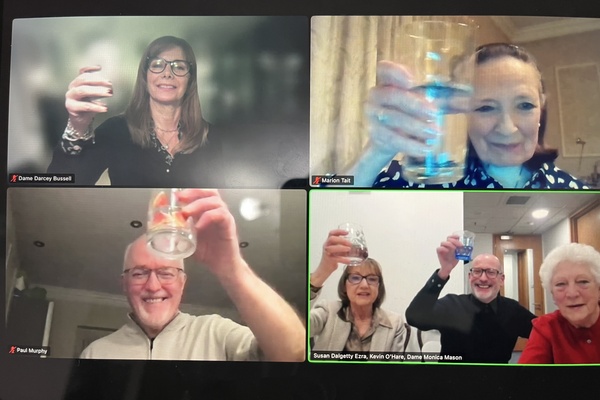
Throughout his long life Sir Peter Wright CBE has been a most significant British ballet dancer, teacher and choreographer. This evening provided an opportunity for old friends and colleagues to reminisce over times spent with him, and Susan Dalgetty Ezra, chair of the London Ballet Circle (LBC), welcomed them together with the wider Zoom audience to the evening’s conversation. LBC, she said, was extremely fortunate to have as its Patron such an esteemed and greatly respected individual and he is held in the highest affection. She was pleased to introduce some of the leading lights of ballet, all of whom have had close association with Sir Peter through the Royal Ballet (RB) and the Birmingham Royal Ballet (BRB).
Taking part in this appreciation of Sir Peter Wright:
• Dame Monica Mason DBE OBE – Former dancer and Director of the RB from 2002-12
• Kevin O’Hare CBE – Former dancer and current Director of the RB, succeeding Dame Monica Mason in 2012
• Paul Murphy – Conductor with BRB since 1992, appointed Music Director in 2024
• Marion Tait CBE – Former dancer, Ballet Mistress, and Assistant Director of BRB until 2021
• Dame Darcey Bussell DBE – Former dancer, guest coach for RB and BRB, President, Royal Academy of Dance
Dame Monica Mason commenced by welcoming Sir Peter who she hoped would be watching; he had been so very special in all of their lives, and she knew there were moments when he felt somewhat forgotten. She had first encountered him 68 years ago while a student at the Royal Ballet School (RBS) where he was teaching, and at just 15 thought he was the most wonderful person she had ever studied with. Young, handsome, and charming; he didn’t shout at the students and all the girls were in love with him. He taught a class called ‘Plastique’ – these days he has no recollection of why it was called by that name! All about movement and music, the things that Peter loves, she said.
Kevin O’Hare noted that he had first worked with Peter when in 1984 Kevin had been given a contract with the Sadler’s Wells Royal Ballet. As a young man he recalled thinking that although Peter was ‘quite old’ he possessed extraordinary energy; the way he took rehearsals for The Sleeping Beauty was incredible. He described to his dancers just how he wanted them to be; each had his or her own individual talent and he wanted every dancer to have their own moment on stage. He can still hear Peter echoing that ‘you’ve got to be sharp; you’ve got to be feisty, luscious, luxurious…..’ When Peter came into the room you immediately felt that you had to do better. But you always felt he was there for you and was immensely approachable.
In Sleeping Beauty Kevin played the Herald and the Beast in Act Three, touring to Newcastle, Bournemouth and the ‘big top’ tent in Cambridge, and on to Birmingham in the autumn of his first year.
At the end of a show Peter might ask if you could do something about your eyebrows or perhaps your hair and you might wonder why he was concerned about that rather than technique. But of course Peter was always concerned about the bigger picture; no matter whether in Sunderland or New Zealand many audience members may not know whether your pirouette was good but they’ll certainly notice your dodgy eyebrows! And, said Kevin, in that respect I think I am turning into Peter…..
Ballet conductor Paul Murphy noted that he had spent just a few years with Peter as Director of BRB; most of his time had been with his successor Sir David Bintley. He recalled other conductors – Barry Wordsworth, Ormsby Wilkins, Bramwell Tovey, and the great New Zealander, Ashley Lawrence, who had died before he started. There had been a vacancy for a staff conductor and he, with two others, had been paid to ‘observe’ for three months after which they all had to conduct for a triple bill programme on tour. Following that he had been invited back in September 1992 to conduct another triple bill, after which he was offered the job.
Marion Tait reckoned that Peter had saved her from pursuing another career! In 1968 she had joined the Royal Ballet Touring Company under John Field and in less than two years it had been decided to merge the touring and resident companies. As many as 26 dancers were chopped from the list and as it was last in, first out, her position seemed vulnerable. But John Field started to give her solos – for which she really did not consider herself ready. She subsequently discovered that Peter had discussed her with John, advising him that they had to ensure that she was retained because she ‘had talent’.
So in about 1970 she became part of a new group of some 16 dancers with guest artists such as Antoinette (Sibley). Anthony (Dowell), and Donald (McCleary) – all the greats, in fact. With Peter in charge. They developed an imaginative repertory, with choreographers such as Glen Tetley and Christopher Bruce, and were offered terrific opportunities, and that’s why Marion has remained with the company all these years.
Were the different venues all around the country ready for such a repertory? Peter thought not, probably very wisely, and so they expanded their work. He had such a comprehensive knowledge of MacMillan, Cranko and others – all ballets which were sure to please audiences. Marion was in her element! While the company was on tour in Manchester, she had an ankle operation. Supposed to be learning the role of Odette/Odile, Peter insisted that she experienced all the rehearsals so that she would be ready to take the role once fit enough. His concern for his dancers’ careers was tremendous, she said.
In due course Peter was able to get them a permanent home in Sadler’s Wells Theatre, although until the proscenium arch was enlarged the small stage precluded staging big classic ballets. Once the company became the Sadler’s Wells Royal Ballet they felt emboldened enough to introduce more dramatic pieces. Marion had been cast as The Girl in Kenneth MacMillan’s The Invitation, a piece which involves a rape scene. There had been comment (from Dame Ninette de Valois, always known simply as ‘Madam’) that this should take place out of sight in the wings with something different happening on the stage, but Kenneth had been insistent that it was all part of the story and should be seen. The often rather outspoken Madam accepted that, and respected Kenneth for standing up to her.
Marion related an incident about Giselle in which Peter had asked if she could do something to distinguish herself from the other villagers in Act One – maybe dye her hair red? She bought a spray can of red hair colouring and applied it prior to going on stage. Some five minutes into her first entry she felt a trickle of red paint running down her face and realised that heat and sweat had released it from her hair…. Well, she said, the mad scene must have been very dramatic, because the red dye was by then running all down her face. She did not think she had ever repeated this hair treatment! But of course, the incident reinforced all of their opinions that Peter was always looking at the whole picture presented to the audience.
Dame Darcey Bussell joined Sadler’s Wells Royal Ballet in 1987 from the RBS. One of the first things you must do, Peter had said, is to change your name. Bussell is not a good stage name. She had laughed and asked what might be suitable? Well, Russell, he replied…. She convinced him that she was not going to bother to change her name.
That would have started with Madam, said Monica, she was incredibly outspoken and certainly changed dancers’ names. She reminded them that Deborah Bull had come in for the same treatment – ‘Bull is no name for a ballerina’. She hadn’t changed her name either.
Madam had been so supportive of the Sadler’s Wells Ballet; she knew it was the ideal company for offering opportunities to young choreographers – such as Peter and Kenneth – who, because they respected her so much, were all terrified of her! Paul also noted that Madam was not afraid to use more ‘difficult’ music for her ballets and had been determined to involve young British composers.
Darcey went on to say that after every show there would be a correction; indeed she felt honoured because she was being noticed. One such was being told to close her mouth! She apparently used to breathe with her mouth open, and it had obviously become an embarrassing habit of which she was unaware. But to this day she remains conscious that she should not look out of breath and gasping for air.
Marion then said that Peter tended to ask Kenneth (MacMillan), or blame him, for things that he himself was going to say. He had said to her that ‘Kenneth thinks’ you might do something about a tooth that appeared to protrude a bit. That would have been quite complex, and she did nothing about it. However, she then became rather too aware of the offending tooth and began to notice in photographs that she was pursing her lips together in an unnatural manner….
Darcey was asked what Peter felt when she left the company to join the RB? She recalled the moment vividly; she had been called into Peter’s office and told there was good news and bad news. Give me the good news first, she had responded. You’ve been offered a role with the RB, he said. The bad news is that you’ll have to leave Sadler’s Wells. She had mixed feelings; she had only just found her place within the company but was now overwhelmed by the news that Kenneth MacMillan wanted to create a ballet on her. Peter had been great, telling her that this is what she might expect as a dancer with potential – but if she wanted to she could come back at any time. And so a major new version of The Prince of the Pagodas was created in 1989 by the RB, starring Darcey and Jonathan Cope.
Monica thought that because Peter respected Kenneth so much as a choreographer there was no way he was going to prevent Darcey from taking that opportunity. Peter understood and nurtured everybody’s career and was always looking after you and anxious to get the best for you.
She went on to say the first time she had actually met Peter was when the Sadler’s Wells tour had visited Johannesburg in 1954. Her ballet teacher had taken her to a matinee and after the show they went for tea in the basement café, into which then came the great names of ballet, and the young Monica approached them with her autograph book. They all signed; Peter Wright, Kenneth MacMillan, and the others. An amazing record of a moment which for her was huge.
He’s still signing autographs, noted Marion. For the recent debut of Yu Kurihara as Odette at BRB her father had come over from Japan. He had been introduced to Peter who had signed his programme ‘to you and your very talented daughter’.
Paul then referred to the vast amount of music which had been squeezed into his relatively short time – some three years – with Peter as Director at Birmingham. The Triple Bills, Sylvia, a revamped Coppelia, and an unforgettable performance of Job at Coventry Cathedral, with Madam in the audience.
He recalled an occasion playing for Concerto. Neither he nor the pianist had any idea of its performing tradition and they were struggling with the tempi. Peter was very calm but said at the end of the day there’s not much we can do about this. It is what it is. So they did their best. Clearly, however, Peter hadn’t forgotten their – relatively minor – disagreement, because at the end they each had a bottle of champagne in their dressing rooms with a note saying he was sorry if they felt he was being tough but they had both done a wonderful job for which he was most grateful.
That reminded Monica of the dances from Aida which she had performed while still at the RBS. On this occasion the opera was to be conducted by an up and coming Italian, Riccardo Muti. Peter had choreographed one particular dance at moderate speed, which Muti then proceeded to increase significantly. Peter was asked if some of the steps could be cut – no, it’s my choreography and I want to see it, was the response. So could Signor Muti be asked to slow down? ‘No’ was again the response, that was the speed he wanted. Peter eventually had to modify his choreography, and they all dashed around to fit it all in. It seemed clear that he couldn’t deal with this less than helpful conductor. Afterwards Kenneth had reminded them the dancing was not important – everybody had come to hear the singing….
Darcey regularly coaches the Principals for Nutcracker and was asked if it remained exactly the same season after season. If appropriate, she said, Peter would introduce a small change, accent something a little differently, always to allow the dancer to look their best in the role. Every time you came back to a role, added Marion, he’d find something else you could do better – phrasing, musicality, whatever. And, added Kevin, Peter says that even with the whole production if there is anything that you think doesn’t work, then just make it better….
Darcey went on to talk about a recent Giselle on which she had been working. Peter was with her in the studio and she asked whether he was happy with the mad scene? Because she knew he had been very specific about the choreography for that scene. And Peter had replied that he wished Desmond had been there to help. Desmond Kelly (Assistant Director of BRB from 1990 until 2008) had been Peter’s right-hand man for many years and now was clearly missed. Desmond had given so much to BRB, and before that to Sadler’s Wells, and Peter had relied on him heavily. Marion noted that Desmond had been The Husband in The Invitation and that he was the most wonderful partner with whom to dance.
Peter has made two versions of Nutcracker and it is clear that he loves having one in Birmingham and one at the Opera House in London. He has also made several versions of Giselle suiting each to the particular company for which it was made – in Canada, Brazil, Germany….
I would just like to mention Sonya (Peter’s wife, Sonya Hana, a dancer and actor), said Marion. What a beautiful couple they were! She was wonderful, a great inspiration for Peter, accompanying them on all their foreign tours.
All agreed that Peter is a real man of the theatre, endlessly creative and so caring of all those who worked with him. And his creativity does not end there; he has done ceramics, is a great painter, he can cope so well with the intricacies of film and television. How fortunate he was to find the role in life in which he really excelled, an extraordinary career. Even at the age of 100, Peter still wants to hear the latest news, to have a good gossip, and, as ever, to be the centre of attention.
Susan concluded the evening by thanking Sir Peter Wright for being such a giant, so caring about dancers and everyone concerned with the theatre, and so full of choreographic talent. Such a wonderful gift to us all! Happy 100th Birthday, Sir Peter!
Sir Peter Wright – 100 years old on 25th November 2026
Trevor Rothwell
18-11-26
© The London Ballet Circle


