Iain Mackay In Conversation
Iain Mackay, Artistic Director of the Royal Ballet School, joins Gerald Dowler in conversation

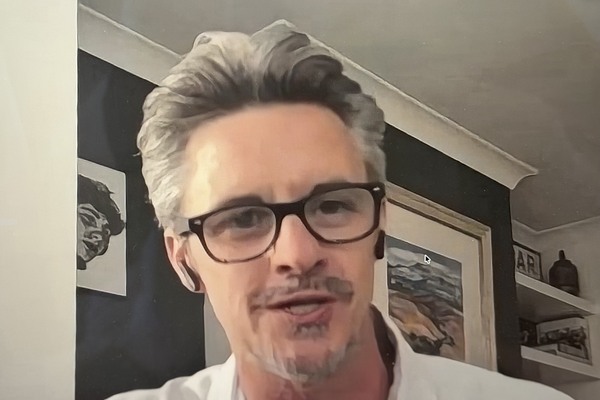
Iain Mackay ‘in conversation’ with Gerald Dowler
20th July 2026
Susan Dalgetty Ezra, Chair of the London Ballet Circle, warmly welcomed Iain Mackay to the evening’s conversation. Glasgow born Iain trained in Scotland and at the Royal Ballet Upper School. He joined Birmingham Royal Ballet (BRB) in 1999, being promoted to Principal in 2003. Following a distinguished stage career, in 2024 he was appointed Artistic Director of the Royal Ballet School (RBS). It's been quite a year for Iain and the school with all the centenary celebrations, said Susan, adding that she was sure that Dame Ninette de Valois, founder of the school, would have enjoyed every minute of it. She also welcomed the well-known dance writer and critic Gerald Dowler, who would lead the evening's conversation.
Gerald commenced the conversation by expressing his pleasure at being invited to talk to Iain. Explaining that he would like to discuss Iain’s current work as director of the school, he intended first to explore some of the earlier influences which might bear on the way he would run the school as director. Why did you want to become director of the RBS?
Iain responded that the path his life took when he joined the RBS as a student was certainly not what he had anticipated. He knew what the school stood for and was desperate to join, but it really changed his life in a way he could never have imagined. That overall experience, he said, has provided me with a really privileged life.
He’d already been working at the school under Christopher Powney when the post of Artistic Director came up and had come to the realisation that there was still so much potential for the school to evolve. Always passionate about supporting young dancers, fostering talent, he felt the job would be the absolute pinnacle of his career which is why he submitted an application – and was lucky enough to land the role!
Many people were very excited at your appointment, said Gerald, after your illustrious career with BRB, and working with Yorkshire Ballet Seminars and the school. But also because of your personal experience of being a student there. That was important, replied Iain, because of my deep sense of gratitude to the school.
However, probably more important was a sense of being at the heart of British ballet throughout his career. David Bintley (Artistic Director of BRB) talked of Dame Ninette all the time and was passionate at ensuring that her values of theatre and storytelling were embedded in all his ballets. The same was true of Marion (Marion Tait, Assistant Director, BRB) and Monica (Dame Monica Mason, Artistic Director of the Royal Ballet) who came to coach the company for certain works. They had such respect for Dame Ninette, who he himself had met just twice, and all that she stood for, and Iain feels deeply the responsibility to continue this tradition.
You were born in Glasgow, said Gerald, so what was the path from there to the Upper School? Iain explained that the first summer school he attended was a Yorkshire Ballet Seminar where David Gayle (founder of the Seminars) told him he should apply to the RBS. At the following year’s seminar Dame Merle Park (Royal Ballet) made a similar suggestion, but at just 13 his parents thought him too young to make such a big decision – instead he joined the Associate programme, eventually joining the RBS itself at 16.
He remembers that when he started at the school he simply hadn't factored in just how good everyone was going to be. Students coming up from White Lodge, students from overseas, there was just this feeling. Darcey Bussell, Irek Mukhamedov, Jonathan Cope, Sarah Wildor…. He remembers being a bit starstruck by everyone and everything.
As Director, in the first assembly of the school year he talks to new students about imposter syndrome. Whether from White Lodge or some other background there will be excitement, nervousness, all of those emotions to which Iain himself relates on so many levels. ‘I'm obviously good enough to be here, but I don't think I'm good enough to be here…..’ Iain thinks that part of the character of people pursuing a career in dance is that they're always questioning; they have the constant desire to improve. He tries to explain that he understands what they're going through – he’s been there before them – believing that can offer some comfort.
They went on to discuss the fact that boys mature physically later than girls. Monica Mason had once said she never really knew how a male dancer was going to turn out till they hit about 25. At my graduating performance, said Iain, some of the lifts had to be changed because I simply wasn’t strong enough to perform them. And yet just a couple of years later, at BRB, he was a strong partner able to tackle every principal role. Although in past years (not today!) ‘baby ballerinas’ aged just 13 might have taken to the stage, at 18 girls can certainly be performing at the highest level.
Another wonderful thing about the RBS is the way in which it constantly monitors and takes account of individual growth and development, and at what point students should be exposed to the pressures of the profession. When directors come in to the school seeking new company members, the smart ones will look for the potential of a student rather than thinking, well, they're 18, they should be able to do that. That potential, said Iain, was obviously what David Bintley saw in me, because I certainly wasn’t fully formed. And as head of the school Iain is delighted when directors say that a student has something which in a year or two will be really special. To Iain that confirms the value of the investment of time and patience in the young dancer.
What about competitions, asked Gerald. If you practise one solo for long enough you will become good at it, responded Iain. But that does not mean that you understand the composition of steps, the structure of ballet. You can learn one song on a piano, or you can learn how to play the instrument and then you can play any song. The school focuses on fostering a deep understanding of technique and artistry – and it’s always been good at that. They can dance MacMillan, they can do Ashton, they can do McGregor….
Do you feel pressure from students who want to progress faster than is right for them, inquired Gerald. Iain thought pressure often came from parents. Students themselves know even the simplest steps in ballet are extremely hard; sometimes parents find that difficult to understand. The RBS has a real duty of care, not just in terms of students’ physical but also their mental well-being; to look at the whole person, how that develops. However, said Iain, I do think there will always be young people who at 16 are just exceptional both technically and artistically.
Did you audition for BRB, asked Gerald. Iain replied that while still a student he had been touring in Japan and China with the Royal Ballet, when he was asked to contact David Bintley – who offered him a job. Iain’s initial thought was ‘no, I want to join the Royal Ballet’. He had already worked with BRB; he liked the company, but did not want to join it. However, Anthony Dowell advised him to accept the offer, to see how he got on, telling him that one day he might return to the Royal Ballet. So he accepted the offer, went to BRB, and his first show was Giselle.
Principals at BRB were kind, generous and supportive and he instantly felt really looked after and given opportunities. Kevin O’Hare was a mentor from day one; recovering from surgery he had time to talk and to help with some rehearsals. The more the opportunities came, the more Iain realised that he was in good place. He had just been thrown into the action – and he loved it! He was already starting to learn the Nutcracker prince in his second year in the company, not believing they trusted him to learn it.
I assume David Bintley was keeping an eye on the way you were progressing, said Gerald. Absolutely, agreed Iain, but another reason was that as a touring company, BRB was often scheduled to give seven performances a week. Injury was thus a constant problem and the ability to learn quickly and slip into any part makes you an invaluable member of the company. You get your opportunity at someone else’s expense! Opportunities which for Iain probably arrived before he was fully formed physically; emotionally he coped through the support offered by great coaches. And, he added, every time you go on stage you discover something new, and that is a really great way to learn the craft.
Iain was then reminded of being thrown in at the last minute in Romeo and Juliet. Rehearsing in Birmingham, he had been phoned on a Thursday evening and told to return to Salford, where the BRB was performing, to dance Romeo with Carol-Anne Millar as Juliet on the following Saturday. The connection between the two dancers in this work is so intimate that couples sometimes rehearse together for months, but he had never danced with Carol-Anne. They rehearsed for ninety minutes on the Friday and then gave what was acknowledged to be a great performance the next day. That’s the essence of life in a touring company, said Iain, the show must go on! You learn to trust your own skills rather than trust that you know the repertoire – an accomplishment certainly contained within the aim of the school to produce properly rounded dancers.
Are you a perfectionist, asked Gerald. All dancers are perfectionists, responded Iain. And I’m such a hypocrite that I spend all my time telling students that perfection doesn’t exist! It was that perfectionist instinct that lay behind his move to dance with the newly formed Corella Ballet in Spain. He had started to doubt his abilities; to think the only reason he was a Principal at BRB (which he had then been for about six years) was because he could jump in to a role at a moment’s notice. And so when the invitation came from Angel Corella he felt he should take the opportunity so that he could again try to justify, to himself, his status as a dancer.
Iain worked in Spain for a couple of years and was starting to think about where to go next when David Bintley phoned and asked him to return to Birmingham. Iain thought hard, decided that the years in Spain had given him more confidence, and that he would definitely be returning as a better dancer; he went on to dance with BRB until his retirement. Iain then praised David as a leader, always supportive, always fair and measured in his response. But so exacting when choreographing in the studio, especially with musicality and stagecraft, pushing himself all the time.
I think flexibility, resilience, and problem-solving abilities are all important attributes within the skill set of a dancer, said Iain in response to another question. You never go out and perform a variation in exactly the same way it has been rehearsed. The dancer must be flexible, able to react to both him or herself, and their partner, moment by moment; able to get back on track after, say, some minor slip. The challenge to build in such resilience, the ability to recover from frustrations, is an essential element of training.
How have social media influenced students’ attitudes, wondered Gerald. They can see so many different versions of a role. Do they still trust coaches? There’s so much external noise, said Iain, confessing to worrying about it a lot. Works had been passed down through the generations by face-to-face teaching; now students can compare themselves with perfection online – or find something that looks different and think ‘that’s an option’. And maybe it is but sometimes it isn’t. It can all be most confusing; young dancers are very vulnerable, and instilling resilience is so important.
Was it difficult to retire from performance, asked Gerald. No, replied Iain. For three or four years prior to his last appearance on stage he had chosen to shadow various aspects of BRB’s management. He had taught a lot, become a Trustee of the Royal Academy of Dance, taken other roles. He was, in fact, itching to challenge himself and explore other avenues. That was when the opportunity with Yorkshire Ballet Seminars came along. There he had to master all manner of disciplines; marketing, accounting, planning, so much administration. But then he would see the students at work and know that he could also offer practical help in the studio.
We’re coming to the end, said Gerald, but finally I’d like to ask about the changes now taking place within the RBS – not all of which have received favourable comment. Basically the early years are being phased out because there are now good dance teachers all over the country, said Iain. Dame Ninette believed that students should be recruited at a young age to ensure their innate talent was developed at a specialist school and not wasted. That was probably quite correct for its time, but it’s no longer the situation, we have effective associate training schemes across the country and local dance training is very good. And parents seem much less happy for their very young sons and daughters to board and prefer them to continue training with their good local teachers. The RBS does not stand alone in this, said Iain, other well-known international ballet schools are transitioning in a similar way.
I've always been struck by how much you care, said Gerald. If I were a parent, I would want my child to have the best technical training possible, but it would be more important to me to have a director who cared and really supported them. That’s what I see at the RBS!
Susan thanked both Iain and Gerald for between them exploring fascinating insights into Iain’s role as Artistic Director of the RBS. She wished the school well in its centenary year, saying that she was sorry she would not be there to enjoy the 200th anniversary! She thanked them both most sincerely for spending their evening with the Circle; it had been delightful.
Trevor Rothwell
23-07-26
© The London Ballet Circle


