BalletBoyz in Conversation
Michael Nunn OBE and William Trevitt OBE join Deborah Weiss in Conversation
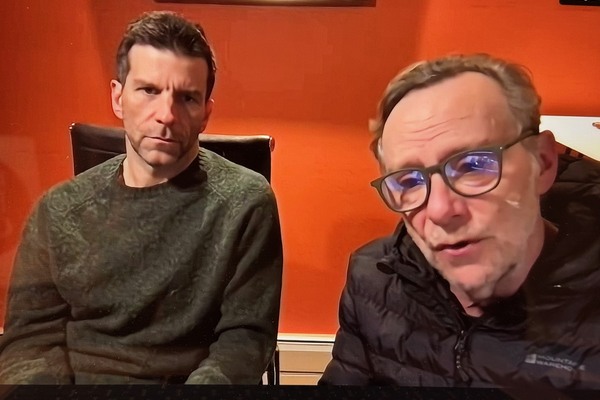
BalletBoyz (Michael Nunn OBE and William Trevitt OBE)
‘in conversation’ with Deborah Weiss
16th March 2026
The BalletBoyz - Michael Nunn and William Trevitt - were warmly welcomed to the evening’s conversation by Susan Dalgetty Ezra, Chair of the London Ballet Circle. Twenty-five years ago two talented young men decided it was time for a new challenge, and BalletBoyz was born. They have been hailed as pioneers for making dance accessible and for reaching a wider audience through their celebrated stage and film work. Tonight they would be in conversation with well-known critic and dance writer Deborah Weiss, who Susan also welcomed.
Let’s start at the beginning, said Deborah. You both joined the Royal Ballet in 1987 with an interest in photography and film and, in due course, that led you to produce a video diary of the Royal Opera House when it was closing for renovation.
Correct, said Michael. We had been taking lots of photographs, for instance, audition pictures for students, when we heard of the imminent closure. The Opera House was full of amazing infrastructure backstage; Margot's dressing room, where Rudolph had been, the submarine engines that drove the stage up and down. Billy and I thought it would be good to make a video archive before it all disappeared. So, rather cheekily, we asked some Board members for cash to buy a camera, and that’s how it happened.
And then, of course, it all started to go wrong, with the Chairman being fired and dancers laid off – but we continued to record it all until toward the end of the film we resigned. We took the completed film to Channel 4 and they aired it as BalletBoyz.
You resigned because you were never going to be able to show it unless you stepped away from the company, suggested Deborah. Nothing to do with the film, was the reply, it was that closure for two years, maybe more, meant uncertainty for the dancers. Rumours were rife, and the active career of a dancer is short. They’d both been working in Japan during the summer, seen the enormous thirst for classical ballet and wondered whether it might be possible to start something there. A big decision for them both! Unfortunately, however, they found the appetite in Japan was for traditional rather than for the new works they wished to produce and decided a return to Europe would be prudent.
With financial support from a friend they decided (rather stupidly, they said) to take on the Roundhouse, in Camden, to launch their company. At that time it was still the empty shell left by British Rail and they built an entire ‘theatrical’ infrastructure within it, spending every penny on a single week of performances. That left them completely broke, off salary, and having to find premises to start working with choreographers and try to raise some funds.
The show had been called Pointless and the first choreographer they had wanted to work with was Russell Maliphant. Unwilling at first to become involved with classical dancers – ‘I do something completely different’ – he was eventually persuaded by their commitment when the company learned his work Critical Mass from tape recordings. They knew Billy (William) Forsythe really well, and he gave them Steptext; Paul Lightfoot gave another work, and with a few other bits and pieces these made up their first programme. This was in October 2001, just after 9/11, which was, of course, terrifying for ticket sales!
When you first started the company name was George Piper Dances? That, they said, combined both their middle names, and had been used for photographic commissions. They hated the name BalletBoyz. The original title for the Opera House film was to have been Michael and Billy’s Royal Ballet, but the company objected to that. So one morning the Channel 4 production company said they would call it BalletBoyz, to which they both responded that it was the worst name they had heard…. Every so often they think about changing the name, but it has served them well, and it is certainly memorable.
I wanted to mention Christopher Wheeldon, said Deborah, some time later you went to Moscow to do a film with him. How did that come about? Michael responded that one of the first pieces Chris did for BalletBoyz had been Mesmerics which they both danced with Oxana (Panchenko). They hired a small studio in New York and Chris would rush in from his rehearsals with New York City Ballet to create with them a 30-minute ballet, with music by Philip Glass. Incredibly creative, open-minded, generous, and wonderful! Still in the repertoire, it now involves five dancers – and they have also done an all-male version.
So can we go back to the filming in Moscow, asked Deborah. Chris had mentioned to them that he was going to Moscow to make a new Hamlet, the first English choreographer to be invited to make a work for the Bolshoi. Might make a good film, they thought, and again approached Channel 4. They agreed, and the next minute Michael and Billy were in Moscow with Chris.
He struggled a bit at first because the dancers were really only interested in Swan Lake and Sleeping Beauty and turned against the idea of a new work. So, with Oxana as interpreter, they accompanied him to the studio every day, created the work, and in the afternoons taught it to the Bolshoi dancers – who had originally assumed they were just the camera crew. Chris started with the younger dancers who were much more interested and ready to accept something new. It worked in the end because they all had to accept it.
It’s a challenge being a choreographer; confronted by 40 dancers all waiting for you to be a genius and create on them something spectacular, and Chris was willing for that somewhat terrifying experience to be recorded by the camera. The ensuing film was incredibly engaging and honest, with nothing held back, and gained an Emmy. The whole exercise had involved quite a measure of vodka consumption. Essential because of the cold and the biting winds……
Michael and Billy thought that the Bolshoi film had been a real pointer as to their future work. They had already discovered they could make films, but this time they had been in complete control and could express themselves in whatever way they wanted – it was the beginning of everything that followed.
They then went on to discuss The Rite of Spring, which Deborah had expected to be rather different, and more of a performance. The film had to be an hour long, said Michael, and the Stravinsky score is only 35-40 minutes. The commissioners also wanted to show the history of the production and how it had been made. So they ended up involving a whole plethora of different dancers – including pole dancers and amateur ballroom dancers. Three different choreographers co-operated, with Paul Roberts doing the bulk of the work.
The BalletBoyz journey to Cuba with the Royal Ballet had been notable for the outbreak of swine flu which kept the dancers confined to a mansion in Havana for much of the time. They had to be in ‘hiding’ because, they said, you were not permitted to have swine flu in Cuba because deportation would immediately follow. Nevertheless it had been a wonderful trip; a gala performance with projection on a big outdoor screen for those who could not get a seat in the theatre.
When they both actually ceased to dance they decided to hire young, inexperienced but very enthusiastic dancers to replace the experience of the two old fellows. Once coalesced into a cohesive group Liam Scarlett was asked to create a work for them. He found a way of working which was just what they had been looking for, so that once there were, say, ten dancers on the stage you became completely unaware of their gender. Although often thought to be an all-male company, because of the name, that was not actually the case – their first show had three men and three women dancers.
It was only when they retired that it became an all-male company because so many choreographers had been interested in the challenge of creating for the two of them, and they felt it worth continuing to offer that challenge to choreographers. They did Young Men – with women in the cast – and more recently England on Fire, which was half men and half women. The first of these involved dressing the dancers in army uniform. While on tour they shot some scenes on Wilacombe Bay beach, with two dancers all mud and sand spattered and Billy the cameraman in the sea! Channel 4 aired it on the 75th Anniversary of D-Day. This short piece seemed to work so they made it into a longer film, including filming in trenches specially dug by a local farmer in northern France to make the battlefields.
And then Deborah said that she had to ask about the Kama Sutra. That had been produced for Sky Arts as a documentary; they had asked that it should be ‘sexy but not sexual’. A difficult brief! They came up with the idea of stereotypical sexual fantasies which could be summoned to various locations when required. They used three choreographers, Javier de Frutos, Paul Roberts and Fernanda Lippi to explore images of sexual energy and intimacy, and the cross-culture of dancers was utterly bizarre!
As a side issue Deborah then wanted to know about the little gigs they sometimes did after a show, playing the guitar, drums and singing. Apparently it had started in Sydney, the audience for the show itself had been most appreciative and they thought they could prolong the warm atmosphere in the theatre. It seemed to work and so they did it again, sometimes including songs relevant to the venue in which they were playing. Just a bit of fun!
Romeo and Juliet. Beyond Words was a beautiful interpretation of the play, an absolute masterpiece, said Deborah. So how did that come about, she asked. During their Royal Ballet careers both men had played more or less every role in MacMillan’s ballet, and they knew it inside out. When it had been staged at the O2 arena they had been asked to provide some short film sequences to be shown while the orchestra played to cover the scene changes (although scene changes for these performances were actually minimal). And that gave rise to the thought that it could be good to film the whole ballet in some realistic location.
They visited Italy to seek venues and realised they could not afford to make it there. Then it was suggested they look at Budapest, at a location at which a film about the Borgias had been shot years ago but the set still survived. They negotiated with the Royal Ballet which was on its way to Madrid but found a window of opportunity to go to Budapest. Kevin (Kevin O’Hare – Artistic Director of the Royal Ballet) had been very helpful over the whole exercise, letting them choose the cast after extensive screen testing. The choice of dancers had been quite radical, not copying the current casting of the Royal Ballet’s own in-house version.
To safely accommodate the dance routines the ground itself was excavated in certain areas and new infrastructure bearing a sprung dance floor constructed, with lino painted to blend in with the rest of the scenery. Accordingly the dancers would be performing on their ‘usual’ floor surface. They had a tight turnaround time which was, of course, rather dependent on the weather as so much was being filmed outside. The balcony scene wind, they noted, was real and not from a machine…. The death scenes in the sword fights were filmed more or less in a single take. The dancers were incredible and seemed to love the experience, and the crew was terrific. Deborah MacMillan had helped them all along the way and used her influence to get the Opera House on board.
The directors had wanted to create an awareness of the people around you and how they were reacting to the action. They felt that the whole project had given a new meaning to the play – according to Michael, some of the young dancers, new to the company, hadn’t even known the story.
After Romeo came England on Fire based on a book by Stephen Ellcock charting the ‘fiery and chaotic’ history of this country. They gave various choreographers and composers chapter headings and asked them to respond. The intention was a research project for a film; they were then offered a week at Sadlers Wells and decided they might as well produce it as a show, and it turned into a really interesting mix. It’s now turned into another feature film Never turn back which they hope to launch this autumn, and which involves some 90 dancers from the ages of 8 to 83! Full of stories and thoughts and really inspiring. There are students from the BRIT school, from Rambert, BalletBoyz alumni – and Shevelle Dynott does a solo in the back of a taxi! It’s quite funny; dark humour.
Craig Revel-Horwood choreographed a piece for you both, said Deborah. Correct, they said, they had requested a tango to represent Rudolf Valentino and Nijinsky, and it was to celebrate the re-opening of the Royal Festival Hall after its refurbishment. It didn’t turn out to be a tango, but it had been very popular. They had been due to perform it on Strictly Come Dancing, but the BBC considered at the time that two men dancing together would not be acceptable….
Last year they did Principles of Classical Dance, inspired by Joan Lawson’s book, full of incredible photographs of a young Anthony Dowell. The intention was to make the best classical dance film possible and so they asked Chris Wheeldon if he’d be interested. They involved talented dancers from the Royal Ballet and hope to stage it next year; they also expect to release the film soon.
What next? They would like to film Giselle, or Manon, all those big works. But, they said, we do want to remain firmly in control. So don’t expect them to be running a big Hollywood studio anytime soon!
Finally they mentioned an upcoming film following students right through the Royal Ballet School from their first year at White Lodge – that should also be available soon.
Susan, Chair of LBC, thanked Michael and Billy most sincerely for a lively and so interesting conversation, led expertly by Deborah. They clearly worked brilliantly together, and it had been great to learn all about the way their partnership had developed. More power to their collective elbows!
Trevor Rothwell 17-03-26
Copyright @ The London Ballet Circle


